Knee Osteoarthritis
A systematic review and meta-analysis of 22 placebo-controlled trials involving more than 1,000 people found reductions in pain and disability when photobiomodulation was delivered within recommended treatment parameters.

If you’ve heard about red light therapy but aren’t quite sure what it does, you’re not alone.
There’s a lot of information out there, and it can quickly become confusing. Different wavelengths, different devices, claims about everything from pain and recovery to skin and healthy ageing. It can be difficult to know where to start.
So let’s make it simpler.
This guide explains what red light therapy is, how it works, what researchers are investigating and what you should know if you’re considering using it at home.
Red light therapy uses specific wavelengths of light to interact with the body’s cells.
You may also hear it called photobiomodulation, or PBM. That’s the scientific name you’ll often see in published research.
Unlike ultraviolet light, red light therapy doesn’t use UV radiation. It generally uses visible red light and invisible near-infrared light.
These wavelengths can travel into the body’s tissues, where the light is absorbed and can influence biological processes within our cells.
The idea might sound very modern, but scientists have been studying the effects of light on the body for decades.
Today, photobiomodulation is being researched across a wide range of areas, including pain, joints, muscles, recovery and movement.
Every cell in your body needs energy to do its job.
Inside many of those cells are tiny structures called mitochondria. They’re often described as the powerhouses of our cells because one of their jobs is helping produce the energy cells need to function.
Certain wavelengths of red and near-infrared light can be absorbed by molecules within our cells. Researchers believe this can influence mitochondrial activity and a range of cellular processes involved in energy production, signalling and the body’s response to stress.
You don’t need to understand all of that biology to understand the basic idea.
This is why researchers are interested in whether photobiomodulation may be useful in areas such as pain, inflammation, tissue recovery, muscle performance and joint function.
It is also why the wavelength, dose and amount of light delivered matter. Red light therapy isn’t simply a case of turning on the brightest light you can find for as long as possible.
We’ll come back to that.
Not all light reaches the body in the same way.
Two wavelengths you’ll see frequently in red light therapy devices are 660nm red light and 850nm near-infrared light.
Red light is visible. It’s the red glow you can actually see when a device is switched on.
Wavelengths around 660nm tend to act closer to the surface of the body.
Near-infrared light sits just beyond the visible spectrum, so our eyes can’t see it.
Wavelengths around 850nm can reach more deeply into tissues than visible red light, which is one reason near-infrared wavelengths are often included in devices intended for muscles and joints.
Exactly how deeply light travels isn’t fixed. It varies depending on the wavelength, the type of tissue and other factors.
That’s why we prefer to think of it simply as:
660nm red light works closer to the skin.
850nm near-infrared light reaches more deeply into tissues.
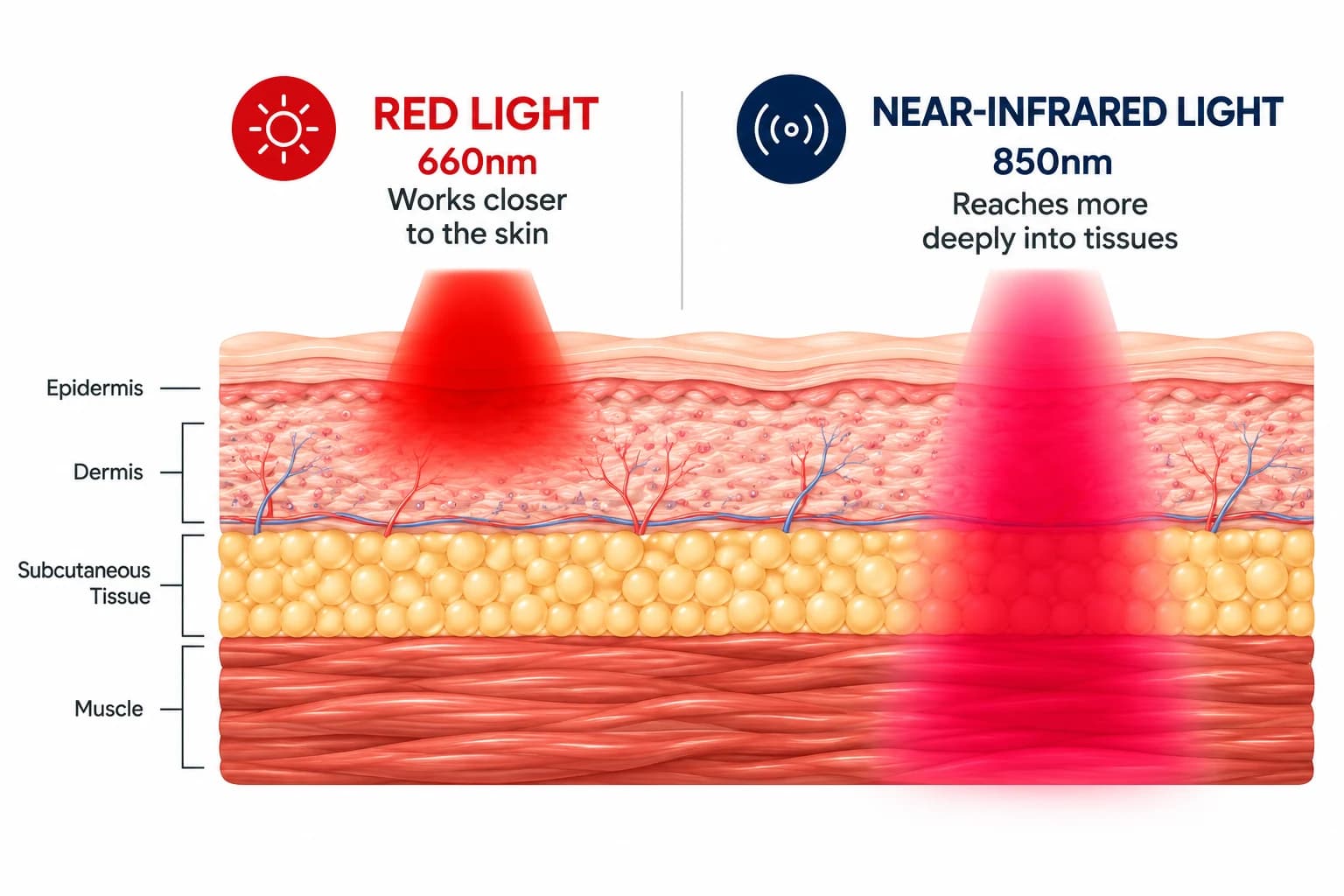
Some red light therapy devices use one wavelength. Others combine red and near-infrared light so that different tissue depths can be exposed during the same session.
This is where red light therapy can start to feel a little overwhelming.
Search online and you’ll find claims that it can help with almost everything. The research is much more complex than that.
Photobiomodulation has been studied across a wide range of areas, including pain, joint conditions, muscle recovery, wound healing and skin health. Researchers are also continuing to explore its potential in other areas.
At Be Pain Free, we’re particularly interested in the research around pain, movement, joints, muscles, recovery and healthy ageing, because these are the things that can have such an impact on everyday life.
We’ve grouped our educational content into four main areas to make it easier to explore.
Pain and stiffness can affect much more than how you feel. They can change how easily you move, how active you are and sometimes stop you doing the things you enjoy.
Photobiomodulation has been studied across a number of musculoskeletal conditions, including knee osteoarthritis, neck pain, shoulder tendinopathy and lower back pain.
The results are encouraging in some areas, but they aren’t identical across every study or every condition. The wavelength, dose, treatment schedule and condition being studied can all influence the results.
Photobiomodulation has also been studied in relation to exercise, muscle performance, soreness and recovery.
Some research suggests benefits in particular circumstances, but again, how the light is delivered matters. More light doesn’t necessarily mean a better result.
Staying active and maintaining movement can become increasingly important as we get older.
There’s growing interest in photobiomodulation across different aspects of ageing, movement, recovery and wellbeing.
This is an evolving area of research, and there’s still a lot we don’t know. We’ll follow the evidence as it develops and share what we learn without getting ahead of the science.
If you’d like to understand more about wavelengths, mitochondria, irradiance, dosage or photobiomodulation itself, this is where we’ll dig a little deeper.
We’ll explain the science in plain English and help make sense of what these terms actually mean when you’re reading about red light therapy or considering a device.
Pain is one of the main reasons people become curious about red light therapy.
It’s also an area where we need to be particularly careful about sweeping statements.
There isn’t one single type of pain, and there isn’t one standard red light therapy treatment that has been tested for every painful condition.
What we do have is a growing body of research into photobiomodulation across a number of musculoskeletal pain conditions.
For example, researchers have studied its use in knee osteoarthritis, neck pain, shoulder tendinopathy and chronic lower back pain, among other conditions.
Some systematic reviews and clinical trials have reported reductions in pain and improvements in function. Others have found smaller effects or results that depend on factors such as wavelength, dose and treatment protocol.
So rather than saying simply “red light therapy works for pain,” we think the more useful question is:
That’s the approach we’ll take throughout Be Pain Free.
A systematic review and meta-analysis of 22 placebo-controlled trials involving more than 1,000 people found reductions in pain and disability when photobiomodulation was delivered within recommended treatment parameters.
A systematic review of 17 randomised controlled trials found clinically relevant pain relief with low level light therapy when appropriate treatment doses were used.
A systematic review and meta-analysis found evidence that low level light therapy may reduce acute and chronic neck pain, while also highlighting differences between the treatment protocols used across studies.
Photobiomodulation has also been studied for lower back pain. Some trials and reviews have reported improvements, but the evidence is more mixed and treatment methods vary considerably.
Yes. One of the reasons red light therapy has become increasingly accessible is that there are now many devices designed specifically for home use.
These range from larger panels and lamps to masks, belts, wraps and wearable devices designed to position the light over a particular area of the body.
The important thing isn’t simply whether a device produces red light.
The wavelength, amount of light delivered, treatment area and how the device is used all matter.
For many people, convenience matters too.
A device that’s easy to position and comfortable to use is more likely to become part of a regular routine than something that’s difficult to set up or requires you to sit in one particular position.
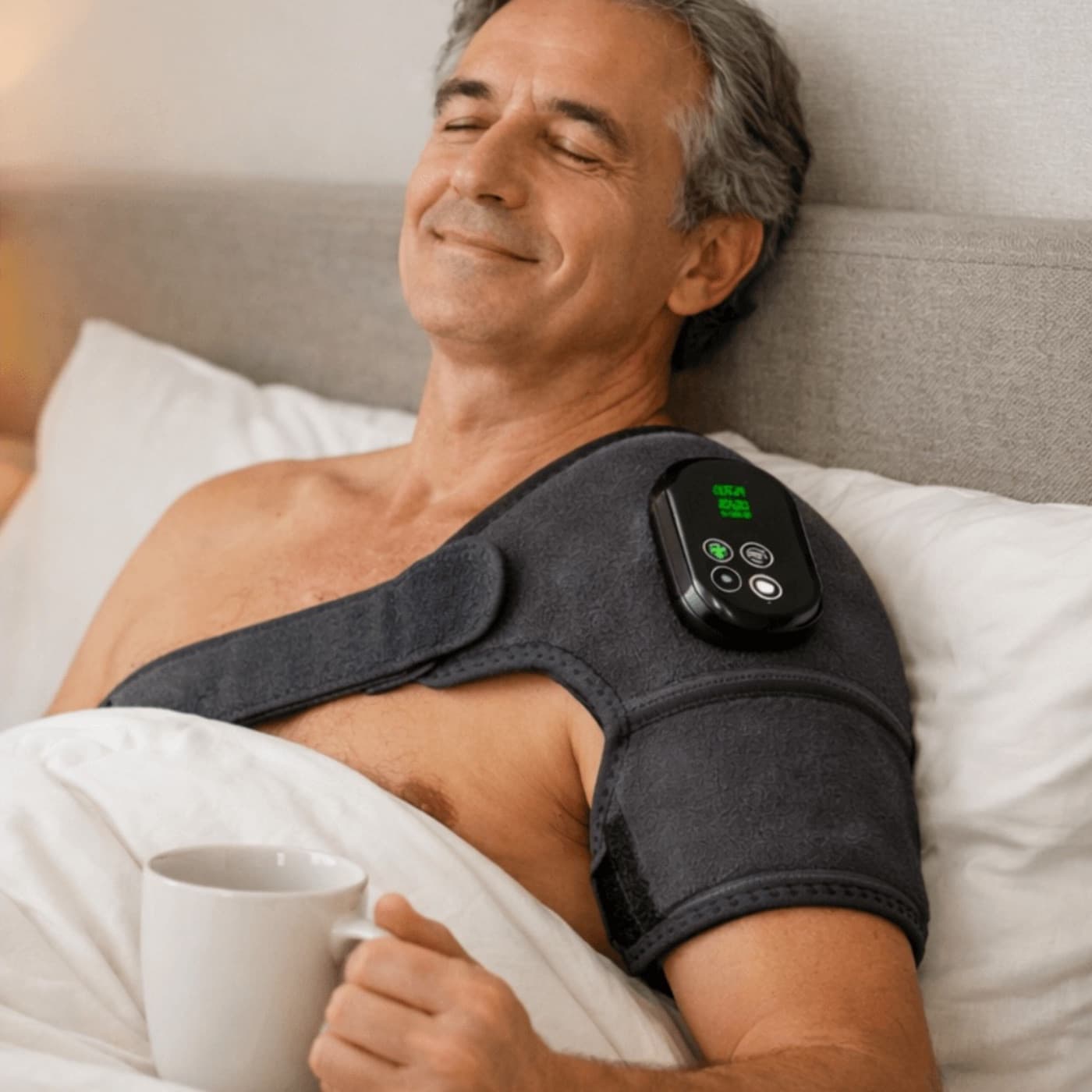
That’s one of the reasons we’ve chosen to focus on wearable red and near-infrared light therapy products at Be Pain Free.
They allow the light source to sit close to the area you want to use it on, while still allowing red light therapy to fit relatively easily into everyday life.
If you’ve ever started comparing red light therapy devices online, you’ll know how quickly the specifications can become confusing.
There are a few things worth understanding.
Wavelength tells you what type of light a device produces.
Red light therapy devices commonly use wavelengths within the red and near-infrared ranges.
At Be Pain Free, our current therapeutic products use 660nm red light and 850nm near-infrared light.
The important point isn’t that these are the only wavelengths that can be used in photobiomodulation. Research has investigated a range of wavelengths.
What matters is understanding what wavelengths a particular device actually delivers.
Irradiance is essentially a measure of how much light power reaches a given area.
You’ll usually see it expressed as mW/cm².
A higher number isn’t automatically better.
The amount of light delivered needs to be considered alongside treatment time, distance from the body and the area being treated.
Dose is one of the most important and most misunderstood parts of red light therapy.
It reflects the amount of light energy delivered over a period of time.
That means intensity and treatment time work together.
A lower intensity used for longer and a higher intensity used for a shorter period can deliver very different treatment doses.
This is also why simply assuming more is better isn’t a good approach to photobiomodulation.
Think about what you actually want to use the device for.
A large panel may make sense for someone wanting broad exposure across a large area of the body.
A wrap or wearable device can make more sense when someone wants to position the light around a particular joint, muscle or area such as the back, shoulder or knee.
Neither format is automatically better. They’re designed for different ways of using light.
This one isn’t particularly scientific, but it matters.
A device can have impressive specifications, but if it’s awkward to use, difficult to position or doesn’t fit into your routine, you may not use it consistently.
For home use, practical design matters too.
This is one of the questions we’re asked most often.
And unfortunately, there isn’t one treatment time that applies to every red light therapy device.
The appropriate treatment time depends on things such as wavelength, irradiance, treatment distance and the dose the device is designed to deliver.
That’s why it’s important to follow the instructions for the particular device you’re using rather than assuming that a longer session will produce a better result.
One of the interesting things about photobiomodulation is that researchers have observed what is known as a biphasic dose response.
In simple terms:
That’s why we prefer to think about red light therapy in terms of appropriate and consistent use, rather than maximum intensity or maximum treatment time.
Red and near-infrared light therapy is generally considered well tolerated when used appropriately.
Unlike ultraviolet light, the wavelengths used in red light therapy don’t expose the skin to UV radiation.
But that doesn’t mean every device should be used in every situation.
Follow the manufacturer’s instructions for the device you’re using, including recommended treatment times, intensity settings and any guidance around eye protection.
If you’re pregnant, have a medical condition, take medication that increases sensitivity to light, have an implanted medical device or are unsure whether red light therapy is appropriate for you, speak with an appropriately qualified health professional before using it.
You should also seek medical advice for persistent, unexplained or worsening pain rather than relying on red light therapy to diagnose or treat the underlying cause.
One of the things you’ll notice when you start reading red light therapy research is that studies don’t all use the same treatment.
Researchers may use different wavelengths, devices, intensities, treatment times, doses and schedules.
They may also be studying completely different conditions.
That’s why it’s difficult to take the result of one study and apply it to every red light therapy device or every person.
We prefer to look at the overall body of evidence, particularly systematic reviews and meta-analyses that bring together the results of multiple studies.
We also look at the details.
That’s the approach we’re taking as we build the Be Pain Free Research Library.
Rather than simply telling you that something is “clinically proven”, we’ll help you understand what the research actually says.
Not exactly.
Red light and near-infrared light are different parts of the light spectrum.
Red light is visible to the human eye. Near-infrared light has a longer wavelength and isn’t visible, but can reach more deeply into tissue.
Many photobiomodulation devices combine both.
No.
Red and near-infrared light therapy works through the interaction between particular wavelengths of light and biological tissue.
Some devices may feel warm during use, but heat isn’t the primary mechanism behind photobiomodulation.
Red light therapy itself shouldn’t be painful.
Most home devices are non-invasive and don’t involve needles, electrical stimulation or breaking the skin.
Always follow the instructions supplied with the device.
Photobiomodulation has been studied across a number of painful conditions, including knee osteoarthritis, neck pain, shoulder tendinopathy and lower back pain.
Some studies and systematic reviews have reported reductions in pain, but results vary according to the condition and treatment parameters.
That’s why we prefer to look at the evidence for the specific type of pain or condition, rather than claiming that red light therapy treats pain generally.
Yes. There are many red and near-infrared light therapy devices designed specifically for home use.
The important things are understanding what the device delivers, following its instructions and choosing a format that suits the area you want to use it on.
There isn’t one answer that applies to every person, condition or device.
Research protocols vary considerably, and photobiomodulation is often studied over a series of treatments rather than as a single session.
Be cautious of anyone promising a guaranteed result within a specific number of treatments.
Not necessarily.
Photobiomodulation is dose dependent, which means both the amount of light and how long it is delivered matter.
Higher intensity or longer treatment isn’t automatically more effective.
There’s a lot more to red light therapy than we can cover on one page.
If you’d like to dig deeper, explore the areas that interest you most.
Explore research into pain, joints, movement and common musculoskeletal conditions.
Learn about photobiomodulation, exercise, muscles, soreness and recovery.
Follow emerging research into red light therapy, movement, recovery and wellbeing as we age.
Understand wavelengths, mitochondria, irradiance, dose and the science behind photobiomodulation without all the jargon.
Explore the studies behind the topics we discuss.
Join Jonathan as he explains red light therapy, pain, movement and recovery in plain English.
We’ve developed our range of red and near-infrared light therapy products to make home use simple and convenient.
Explore our range and find the format that best suits how and where you’d like to use red light therapy.