
Making sense of the research behind red light therapy
There’s a growing body of research into photobiomodulation, the scientific term commonly used for red and near-infrared light therapy.
There’s also a lot of information online about what that research supposedly proves.
We think there’s a difference.
Research into photobiomodulation is growing rapidly, with studies exploring its effects across pain, movement, recovery, physical function, healthy ageing and cellular health.
Different studies use different wavelengths, doses, devices and treatment schedules, so understanding how the research was conducted helps us make sense of what researchers are finding.
So rather than simply giving you a long list of scientific papers, we’re building this library to help you understand what researchers actually studied, what they found and what we can reasonably take from it.
And if you’d like to go deeper, we’ll always link you to the research so you can read it for yourself.
There’s fascinating research behind red light therapy. We’ll help you understand what researchers are finding and why it matters.
Explore the Research
Choose a topic to see what researchers studied, what they found and what we take from it. Every study links straight through to its record on PubMed so you can read it for yourself.
Joints & Movement
Research into knees, shoulders, tendons, neck, back, feet and the jaw.
Explore Research
Muscles & Recovery
Research into exercise, muscle soreness, fatigue, physical performance and recovery.
Explore Research
Healthy Ageing
Research into physical function, cognition, cellular health and skin.
Explore Research
The Science Behind Red Light Therapy
Research into cells, mitochondria, wavelengths, light penetration and dose.
Explore ResearchJoints & Movement
Pain, stiffness and changes in movement are some of the most common reasons people become interested in red light therapy.
Photobiomodulation has been studied across a number of musculoskeletal conditions, from knees and shoulders to necks, backs, feet and the jaw.
Research across these areas is helping us better understand how photobiomodulation may support pain, physical function and movement.
Here are some of the findings we find particularly interesting.
Knee Osteoarthritis
What have researchers found?
Knee osteoarthritis is one of the areas where photobiomodulation has been studied for pain and physical function.
A 2024 systematic review and meta-analysis brought together 10 placebo-controlled studies involving 542 people with knee osteoarthritis.
The researchers found that people receiving photobiomodulation reported less pain at rest than those receiving placebo treatment.
What does this mean?
These findings add to the growing research interest in photobiomodulation for knee osteoarthritis, particularly its potential role in reducing pain.
For people whose knee pain affects walking, exercise and everyday movement, this is an important area of research and one we’ll continue to follow.
The Research
Oliveira S et al. Effectiveness of Photobiomodulation in Reducing Pain and Disability in Patients With Knee Osteoarthritis: A Systematic Review With Meta-Analysis. Physical Therapy, 2024.
Systematic Review & Meta-Analysis
Shoulders & Tendons
What have researchers found?
Photobiomodulation has been studied in people with tendon related pain, including conditions affecting the shoulder.
A systematic review involving 17 randomised trials and 835 people with tendinopathy found that photobiomodulation used alongside exercise was associated with greater improvements in pain and function than placebo treatment alongside exercise.
Earlier research specifically looking at shoulder tendinopathy also reported improvements in pain when appropriate treatment doses were used.
Interestingly, studies using inadequate doses didn’t show the same benefit.
What does this mean?
The findings are particularly interesting because photobiomodulation was used alongside exercise, with greater improvements in pain and function than exercise with placebo treatment.
This suggests PBM may be a useful addition to an active approach to tendon recovery.
It also gives us another reminder that dose matters.
Red light therapy isn’t simply about using more light. How it is used matters too.
The Research
Tripodi N et al. The effect of low-level red and near-infrared photobiomodulation on pain and function in tendinopathy: a systematic review and meta-analysis of randomized control trials. BMC Sports Science, Medicine and Rehabilitation, 2021.
Systematic Review & Meta-Analysis
Neck Pain
What have researchers found?
Neck pain can affect everything from turning your head while driving to working at a computer or simply finding a comfortable sleeping position.
Researchers have investigated photobiomodulation across different types of neck pain.
A systematic review examining 17 trials found encouraging evidence for chronic neck pain, including improvements in pain and some measures of function and quality of life.
The researchers also found that results varied according to the type of neck pain and the treatment being studied.
What does this mean?
These findings are encouraging for an area that can have such a significant impact on everyday movement, work and sleep.
They also reinforce something we see repeatedly in PBM research:
The condition being studied and the way the light is delivered matter.
The Research
Gross AR et al. Low Level Laser Therapy (LLLT) for Neck Pain: A Systematic Review and Meta-Regression. The Open Orthopaedics Journal, 2013.
Systematic Review
Back Pain
What have researchers found?
Back pain is one of the most common reasons people become interested in red light therapy, and it has also been investigated in photobiomodulation research.
One meta-analysis brought together 15 studies involving more than 1,000 people with chronic nonspecific low back pain.
It found encouraging short-term reductions in pain, particularly in studies using higher light doses and in people who had experienced back pain for a shorter period of time.
What does this mean?
The findings are encouraging, particularly because the analysis included more than 1,000 people with chronic nonspecific low back pain.
They also highlight something important in PBM research: dose and treatment approach matter.
Understanding which protocols produce the best results is an important part of where the research is heading.
The Research
Glazov G, Yelland M, Emery J. Low-level laser therapy for chronic non-specific low back pain: a meta-analysis of randomised controlled trials. Acupuncture in Medicine, 2016.
Meta-Analysis of Randomised Controlled Trials
Foot Pain & Plantar Fasciitis
What have researchers found?
Anyone who has experienced plantar fasciitis knows how much a sore foot can change the way you move.
Photobiomodulation has been investigated for plantar fasciitis, including its effects on pain and foot function.
Systematic reviews of randomised trials have reported improvements in pain and foot function following photobiomodulation.
Researchers have also noted considerable differences in the light doses and treatment protocols used across studies.
What does this mean?
We find this particularly interesting because our feet influence almost every step we take.
The findings are encouraging for people dealing with plantar fasciitis, particularly the improvements researchers found in short- term pain.
They also reinforce the importance of dose and treatment protocol when looking at PBM research.
The Research
A 2023 systematic review and meta-analysis brought together 19 randomised trials involving 1,089 people with plantar fasciitis.
The researchers found that PBM improved short-term pain intensity, including when used alone or with exercise. The evidence around improvements in disability was less certain.
Ferlito JV et al. Effects of photobiomodulation therapy (PBMT) on the management of pain intensity and disability in plantar fasciitis: systematic review and meta-analysis. Lasers in Medical Science, 2023.
Systematic Review & Meta-Analysis
Jaw & TMJ
What have researchers found?
Pain around the jaw and temporomandibular joint can affect surprisingly simple things like eating, talking, yawning and opening the mouth comfortably.
Photobiomodulation has been studied in people with temporomandibular disorders, or TMD, looking at outcomes including pain and jaw movement.
Systematic reviews have reported encouraging findings, with a number of studies showing reductions in pain and improvements in measures of mouth opening and jaw function.
Researchers have also found that results can vary according to factors such as wavelength, power, treatment frequency and treatment duration.
What does this mean?
TMJ research is a fascinating example of photobiomodulation being investigated in an area people may not immediately associate with red light therapy.
It also shows why we keep coming back to treatment parameters.
Different wavelengths, doses and treatment schedules can influence the results researchers observe.
It’s another reminder that “red light therapy” isn’t one identical treatment in every study.
The Research
da Silveira RB et al. Effect of photobiomodulation treatment on pain control in patients with temporomandibular dysfunction disorder: systematic review. 2025.
Systematic Review
Farshidfar N et al. The Effect of Photobiomodulation on Temporomandibular Pain and Functions in Patients With Temporomandibular Disorders: An Updated Systematic Review of the Current Randomized Controlled Trials. Journal of Lasers in Medical Sciences, 2023.
Updated Systematic Review
What Can We Take From All of This?
One of the things we’ve learned from reading photobiomodulation research is that asking simply:
“Does red light therapy work?”
doesn’t always give us a particularly useful answer.
Better questions are:
- What was being studied?
- Who participated?
- What wavelength and dose were used?
- How was the light delivered?
- How often was it used?
- Was photobiomodulation used on its own or alongside something else?
- And what did the researchers actually find?
Taken together, this research helps explain why photobiomodulation has attracted so much interest across joints, pain and movement.
Researchers have reported encouraging findings across several different areas, while also showing us that wavelength, dose, treatment approach and the condition being studied can influence the outcome.
For us, that doesn’t make the research less interesting. It makes understanding how red light therapy is used even more important.
That’s what this Research Library is about: understanding the evidence, following where the science is heading and sharing what we learn along the way.
Muscles & Recovery
Muscle recovery isn’t only something athletes think about.
It matters after exercise, physical work, gardening, walking, sport or simply doing more than your body is used to.
Researchers have been studying photobiomodulation across muscle soreness, fatigue, endurance and the recovery of muscle function.
Here are some of the areas we’re following.
Muscle Soreness & DOMS
What have researchers found?
Most of us have experienced the soreness that can appear a day or two after unfamiliar or demanding activity.
It’s often called delayed onset muscle soreness, or DOMS.
A 2025 systematic review examined 14 studies investigating photobiomodulation following exercise induced muscle soreness.
When the researchers combined the available data, they found reductions in soreness at 72 and 96 hours, as well as improvements in muscle strength during the earlier stages of recovery.
What does this mean?
The findings help explain why muscle soreness and recovery have become such active areas of photobiomodulation research.
For people who want to remain active, recovery isn’t simply about feeling comfortable after exercise.
It’s also about how well the muscles regain their ability to work again.
These findings suggest photobiomodulation can play a useful role in supporting muscle recovery, including soreness and the return of muscle strength after demanding activity.
The Research
Tsou Y-A, Chang N-J, Chang W-D. Effects of Photomodulation Therapy for Delayed Onset Muscle Soreness: A Systematic Review and Meta-Analysis. Journal of Functional Morphology and Kinesiology, 2025.
Systematic Review & Meta-Analysis
Recovery After Exercise
What have researchers found?
An interesting part of photobiomodulation research is that the light isn’t always used after physical activity.
A 2025 systematic review and meta-analysis examined different approaches to muscle recovery and included 19 studies involving 672 participants.
The researchers found that photobiomodulation applied before exercise reduced muscle soreness and improved muscle performance 24 hours after exercise induced muscle damage.
The evidence for reduced soreness was rated as low certainty, so further research will help refine the most effective treatment approaches.
What does this mean?
We often think about recovery as something that begins once exercise is over.
This research suggests the story may be more interesting than that.
Photobiomodulation is being investigated not only as something used after activity, but also as a way of supporting the muscles before they’re challenged.
Recovery may begin earlier than we think.
The Research
Canez MS et al. Effects of photobiomodulation, intermittent pneumatic compression and neuromuscular electrical stimulation on muscle recovery: Systematic review with meta-analysis. Journal of Bodywork and Movement Therapies, 2025.
Systematic Review & Meta-Analysis
Muscle Fatigue
What have researchers found?
Muscle fatigue is that familiar point where muscles become less able to keep doing the work we’re asking of them.
A systematic review and meta-analysis looked at photobiomodulation and functional performance in 16 studies involving 340 healthy people.
The researchers found that PBM helped with fatigue recovery.
They didn’t find evidence that photobiomodulation on its own increased muscle strength or overall functional capacity.
What does this mean?
We think this distinction is important.
Red light therapy isn’t creating strength without exercise.
Instead, the research suggests its more interesting role may be around how muscles respond to activity and recover from fatigue.
That fits with the way we think about photobiomodulation generally:
Supporting the body doesn’t mean replacing the work the body still needs to do.
The Research
Bezerra LO et al. Effects of photobiomodulation therapy on the functional performance of healthy individuals: a systematic review with meta-analysis. Lasers in Medical Science, 2024.
Systematic Review & Meta-Analysis
Muscle Endurance
What have researchers found?
Researchers have also looked at whether photobiomodulation used before exercise can influence muscle endurance and subsequent recovery.
A 2024 meta-analysis brought together randomised controlled trials involving both trained and untrained people.
The results suggested that PBM used before exercise could improve muscle endurance and support recovery of muscle strength and markers associated with muscle damage.
The size of the effect varied depending on the activity level of the participants.
What does this mean?
What makes these findings particularly interesting is the effect on muscle endurance and recovery.
The research suggests photobiomodulation may influence how long muscles can continue working and how they recover after being challenged.
That’s one reason timing has become such an interesting part of PBM research.
The Research
Li B-M et al. Can pre-exercise photobiomodulation improve muscle endurance and promote recovery from muscle strength and injuries in people with different activity levels? A meta-analysis of randomized controlled trials. Lasers in Medical Science, 2024.
Meta-Analysis of Randomised Controlled Trials
Exercise & Physical Performance
What have researchers found?
Photobiomodulation has also been studied as a way of supporting different types of physical performance.
A 2022 systematic review and meta-analysis included 37 studies and 586 participants.
The researchers found improvements in some specific measures, including single joint muscle endurance and cycling time to exhaustion.
But benefits weren’t found across every type of exercise.
For example, the review didn’t find improvements in muscle strength, running performance or swimming time trial performance.
What does this mean?
“Physical performance” isn’t one single thing.
Strength, endurance, sprinting and prolonged exercise all place different demands on the body.
The research suggests photobiomodulation may be more useful for some aspects of performance than others.
For us, the most interesting part isn’t whether red light can make someone a faster athlete.
It’s what this research may teach us about muscle endurance, fatigue and recovery.
The Research
Dutra YM et al. Deconstructing the Ergogenic Effects of Photobiomodulation: A Systematic Review and Meta-analysis of its Efficacy in Improving Mode-Specific Exercise Performance in Humans. Sports Medicine, 2022.
Systematic Review & Meta-Analysis
What Can We Take From This Research?
One of the most interesting things about the muscle research is that photobiomodulation isn’t being studied for just one outcome.
Researchers are looking at:
- Soreness
- Fatigue
- Endurance
- Recovery of muscle function
- Performance after physical activity
The research points to a particularly interesting role for photobiomodulation around activity: supporting soreness, fatigue, endurance and recovery of muscle function.
Timing appears to matter too, with some encouraging research using PBM before activity rather than waiting until muscles are already sore.
For people who want to stay active, recover well and keep moving, this is an exciting area of research to follow.
Healthy Ageing
Ageing is part of life, but how we move, think, recover and function as we get older matters enormously.
This is also becoming an interesting area of photobiomodulation research.
Scientists are investigating PBM across a surprisingly broad range of areas in older adults, from physical function and muscle fatigue to brain function and skin.
It’s a fascinating and growing area of research, with studies exploring how PBM may support different aspects of health and function as we age.
Photobiomodulation & Healthy Ageing
What have researchers found?
A 2024 systematic review specifically looked at the use of photobiomodulation in older adults.
The researchers identified 10 studies looking at photobiomodulation across several different health conditions affecting older adults. Treatment approaches varied considerably, including different wavelengths, devices, treatment times and pulsing protocols.
Across the studies, the findings were mixed but encouraging enough for the researchers to describe photobiomodulation as a promising complementary approach. They also reported good compliance and safety across the included studies.
They also emphasised that more research is needed to determine which treatment protocols and applications are most useful.
What does this mean?
This research gives us a useful view of the bigger picture.
Photobiomodulation isn’t being investigated as something that somehow “stops ageing”.
Researchers are exploring whether light can influence particular biological processes and aspects of health that become increasingly relevant as we grow older.
For us, healthy ageing isn’t about trying not to age. It’s about supporting the body to keep doing the things that matter to us for as long as possible.
The Research
Godaert L, Dramé M. Efficacy of Photobiomodulation Therapy in Older Adults: A Systematic Review. Biomedicines, 2024.
Systematic Review
Staying Strong & Physically Capable
What have researchers found?
Maintaining muscle function and physical capacity becomes increasingly important as we get older.
A 2024 review examined photobiomodulation used alongside resistance exercise in adults aged 60 and over.
It included 10 studies investigating outcomes such as muscle measures, fatigue, balance, physical capacity and performance.
In most of the included studies, PBM used alongside resistance exercise was associated with improvements in muscle measures, functional capacity or physical performance, or reductions in fatigue, compared with control groups.
The researchers also emphasised the importance of treatment dose and other PBM parameters.
What does this mean?
This is particularly interesting because maintaining physical ability as we age isn’t simply about building bigger muscles.
It’s about being able to get up, walk, carry things, exercise, maintain balance and continue participating in everyday life.
PBM was studied alongside resistance exercise, with most of the included studies reporting improvements in areas such as muscle measures, functional capacity, physical performance or fatigue.
Movement still matters. The exciting question is how PBM may help support the body around that movement.
The Research
Kumar P, Umakanth S, Girish N. Photobiomodulation therapy as an adjunct to resistance exercises on muscle metrics, functional balance, functional capacity, and physical performance among older adults: A systematic scoping review. Lasers in Medical Science, 2024.
Systematic Scoping Review
Brain & Cognitive Function
What have researchers found?
One of the most fascinating areas of PBM research involves the brain.
Researchers are studying transcranial photobiomodulation, where light is delivered through the scalp, to investigate whether it may influence brain activity and cognitive function.
A systematic review and meta-analysis examining people with age related cognitive impairment reported an overall improvement in global cognition following PBM, although results differed according to treatment parameters and the researchers called for further high quality studies.
More recently, a 2025 randomised study investigated 55 healthy older adults.
After active transcranial PBM, participants performed better on a challenging working memory task than following sham treatment. Researchers also observed changes in functional brain networks associated with that improvement.
They concluded that larger studies are needed to confirm the findings.
What does this mean?
This is an emerging area, but an intriguing one.
Rather than thinking only about muscles and joints, PBM researchers are asking whether light may also influence how the ageing brain functions and communicates.
The research doesn’t mean that ordinary red light devices should be used to treat cognitive impairment. The studies use particular transcranial devices, wavelengths and protocols.
But from a research perspective, it demonstrates just how broad the study of photobiomodulation has become.
The brain may be one of the most fascinating frontiers in red light research.
The Research
Gao Y et al. Effectiveness of photobiomodulation for people with age-related cognitive impairment: a systematic review and meta-analysis. Lasers in Medical Science, 2023.
Systematic Review & Meta-Analysis
Yang Q et al. Transcranial photobiomodulation improves functional brain networks and working memory in healthy older adults: An fNIRS study. NeuroImage, 2025.
Randomised Controlled Trial
Skin Health
What have researchers found?
Skin is another area where red light has attracted considerable research interest.
A randomised clinical trial involving 137 women aged 40 to 65 compared red light at 660 nm with amber light at 590 nm.
Participants received 10 treatment sessions over four weeks.
The researchers reported approximately a 30% reduction in wrinkle volume around the eyes with both wavelengths.
Interestingly, the treatments did not significantly improve skin hydration or elasticity.
What does this mean?
This is a lovely example of why looking at the actual study matters.
A reduction of approximately 30% in wrinkle volume is a significant and interesting finding.
What makes the study particularly useful is that it measured several different aspects of the skin. Wrinkle volume improved, while hydration and elasticity did not significantly change.
That gives us a much clearer picture of where red light produced a measurable result.
The Research
Mota LR et al. Photobiomodulation Reduces Periocular Wrinkle Volume by 30%: A Randomized Controlled Trial. Photobiomodulation, Photomedicine, and Laser Surgery, 2023.
Randomised Controlled Trial
What Can We Take From This Research?
Healthy ageing is much broader than any one condition.
It’s about maintaining the ability to move, think, participate and continue doing the things we enjoy.
And that’s what makes this area of photobiomodulation research so interesting.
Researchers are investigating PBM across different tissues and very different aspects of ageing.
This research shows just how broadly photobiomodulation is now being explored in healthy ageing, from physical function and muscle performance to cognition, cellular health and skin.
Could light become one of the tools we use to support the body as it ages?
The growing research in this area gives us plenty of reason to keep exploring that possibility.
The Science Behind Red Light Therapy
Red light therapy can sound surprisingly simple.
Shine particular wavelengths of light onto the body and biological processes may respond.
But what happens between the light reaching the body and the body responding to it is where photobiomodulation becomes fascinating.
Researchers have been investigating these mechanisms for decades.
We don’t have every answer yet, and scientists continue to debate some of the finer details. But we do understand enough to begin explaining how light can act as a biological signal rather than simply something we see or feel.
Here’s some of the science we’re following.
What Happens When Light Reaches Our Cells?
What have researchers found?
For photobiomodulation to produce a biological response, light first needs to interact with molecules within our cells.
One of the leading mechanisms researchers have investigated involves cytochrome c oxidase, an enzyme found within mitochondria.
When particular wavelengths of red and near-infrared light are absorbed, researchers believe this interaction can influence processes involving cellular energy, signalling molecules and other biological responses.
Those initial changes may then trigger a cascade of activity within the cell.
What does this mean?
The important idea is surprisingly simple:
Light can carry information that living cells respond to.
Photobiomodulation isn’t simply about warming tissue or producing a bright red glow.
The light itself can interact with biological systems.
Scientists are still investigating exactly which mechanisms are most important, and cytochrome c oxidase isn’t necessarily the only photoacceptor involved.
But understanding these cellular interactions gives us the foundation for understanding PBM.
The Research
Hamblin MR. Mechanisms and applications of the anti-inflammatory effects of photobiomodulation. AIMS Biophysics, 2017.
Mechanism Review
Why Do Mitochondria Matter?
What have researchers found?
Mitochondria are tiny structures found inside most of our cells.
They’re often described as the cell’s “powerhouses” because one of their important jobs is helping produce ATP, a molecule cells use to power many of their activities.
But mitochondria do much more than simply produce energy.
They also participate in cellular signalling and help cells respond to changes in their environment.
A 2024 review of photobiomodulation mechanisms describes how red and near-infrared light may influence mitochondrial activity and downstream processes involving ATP, reactive oxygen species, nitric oxide, calcium and cellular signalling.
What does this mean?
You’ll sometimes hear red light therapy described as simply “giving your cells more energy.”
We think that’s a little too simplistic.
The more interesting story is that light may influence mitochondrial activity and initiate signals that affect the way cells behave and respond.
Mitochondria aren’t simply batteries being recharged. They’re part of a much more complex biological conversation.
And researchers are still working to understand that conversation.
The Research
Maghfour J et al. Photobiomodulation CME part I: Overview and mechanism of action. Journal of the American Academy of Dermatology, 2024.
Scientific Review
Why Do Wavelengths Matter?
What have researchers found?
Not all light behaves the same way when it reaches the body.
The wavelength of light influences how it interacts with tissue and how deeply some of that light may travel.
Visible red light generally interacts more superficially, while longer near-infrared wavelengths can penetrate further into tissue.
But there isn’t one fixed depth for a particular wavelength.
Research examining the penetration of visible and near-infrared light through different tissues shows just how much penetration can vary according to factors such as wavelength, tissue thickness and the anatomical area being treated.
What does this mean?
This is why statements such as:
“850nm penetrates exactly X centimetres” can be misleading.
The human body isn’t a uniform block of material.
Skin, fat, muscle, bone and other tissues interact with light differently.
A more useful way to understand it is:
Red light generally acts more superficially.
Near-infrared light can reach deeper tissues.
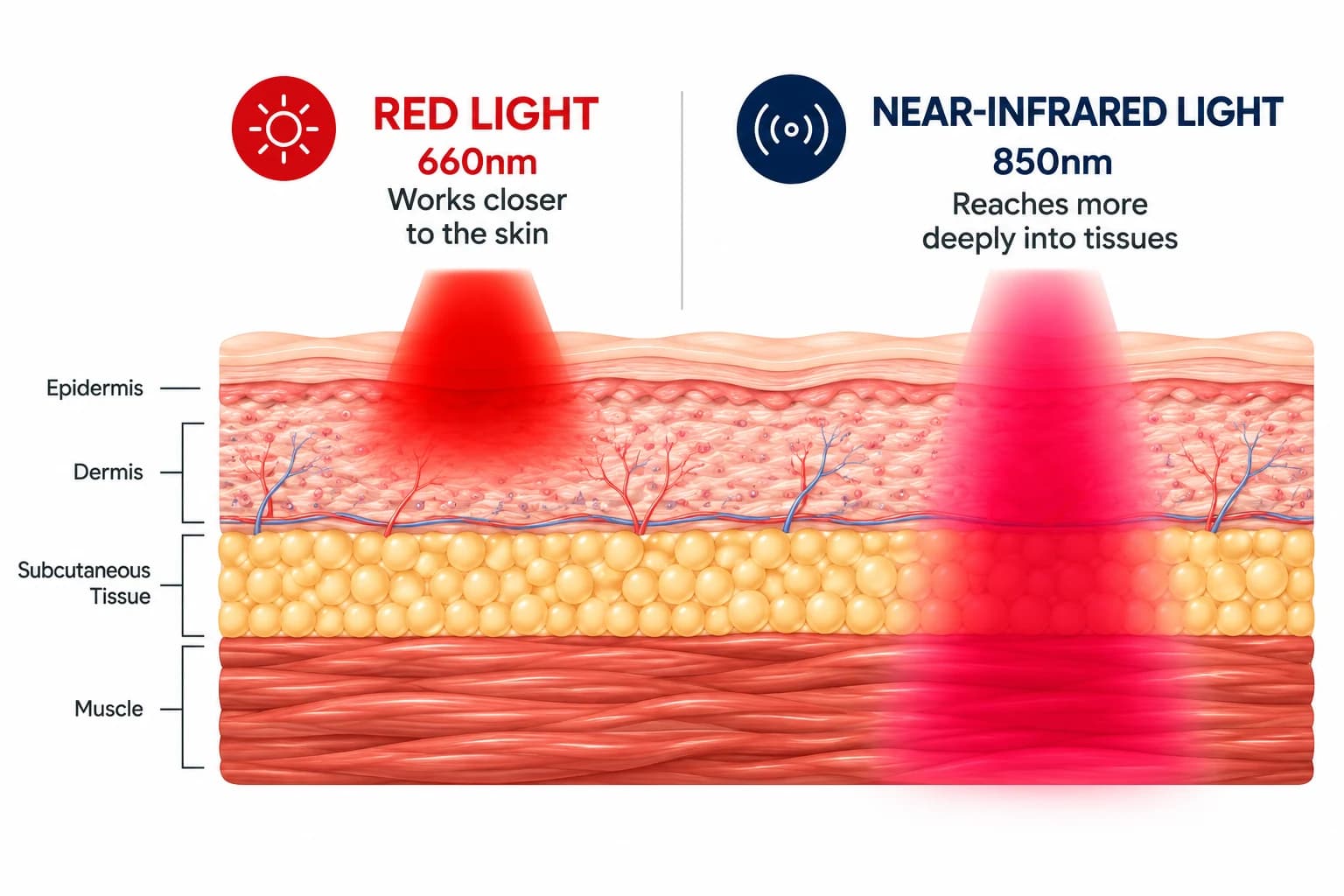
That’s also one reason many photobiomodulation devices combine red and near-infrared wavelengths.
The Research
Salehpour F et al. Penetration Profiles of Visible and Near-Infrared Lasers and Light-Emitting Diode Light Through the Head Tissues in Animal and Human Species: A Review of Literature. Photobiomodulation, Photomedicine, and Laser Surgery, 2019.
Scientific Review
Why Isn’t More Light Always Better?
What have researchers found?
It’s tempting to assume that if some red light is useful, more must be better.
Photobiomodulation doesn’t appear to work that way.
Researchers have observed what is known as a biphasic dose response.
In simple terms, there may be a useful range of light exposure where a biological response occurs.
Too little may not produce enough of a response.
But once an effective range has been reached, continuing to increase the dose doesn’t necessarily produce a greater benefit and may sometimes reduce the desired response.
A major review of PBM dosing research examined this phenomenon across laboratory, animal and clinical studies.
What does this mean?
This is one of the most useful concepts for anyone using red light therapy to understand.
More isn’t necessarily better. The right amount matters.
And “the right amount” isn’t one universal number.
Dose depends on several things, including wavelength, irradiance, treatment time, distance from the light and the tissue or condition being studied.
That’s why we encourage people to follow the instructions for their particular device rather than simply using the highest intensity for the longest possible time.
The Research
Huang Y-Y et al. Biphasic dose response in low level light therapy: an update. Dose-Response, 2011.
Scientific Review
How Does Light Become a Biological Response?
What have researchers found?
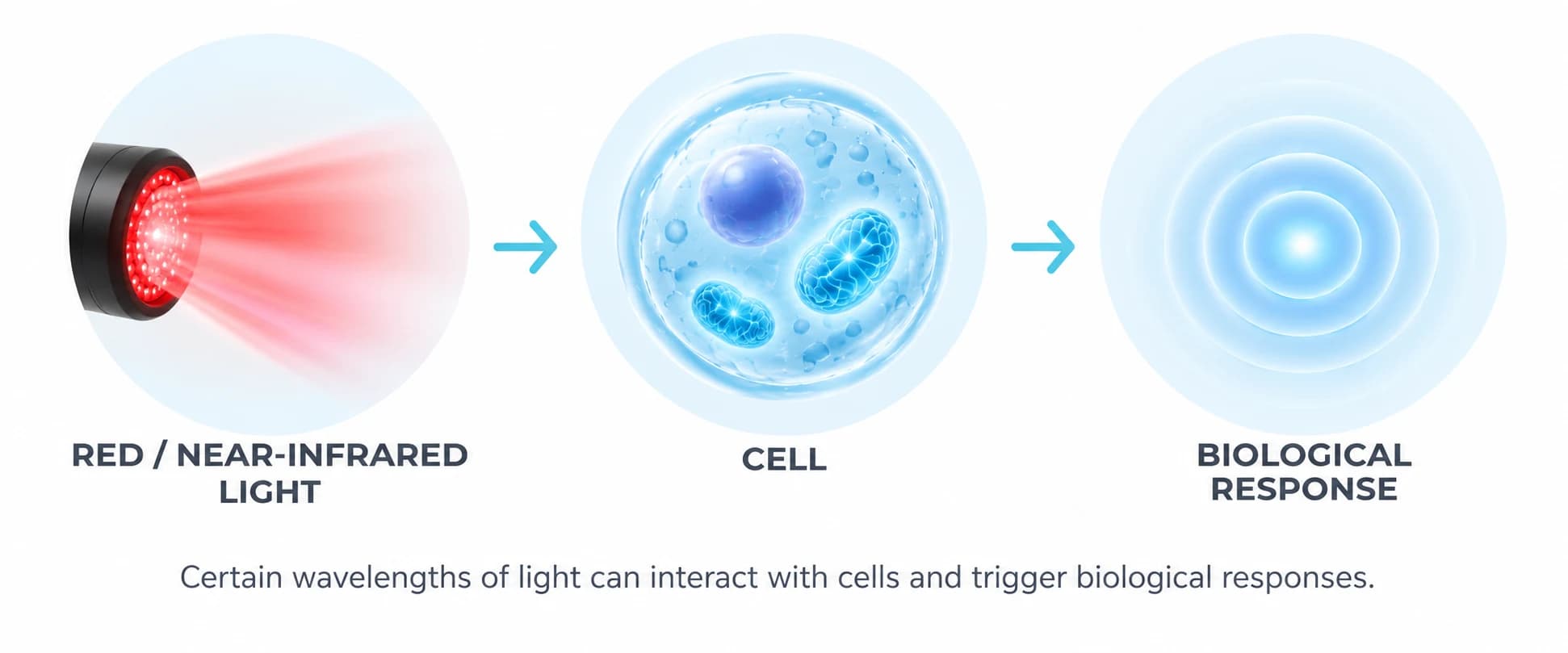
One of the most fascinating things about photobiomodulation is that the light interaction itself is only the beginning.
Once light has been absorbed by cellular molecules, researchers have observed changes involving things such as ATP, nitric oxide, reactive oxygen species and calcium signalling.
Those changes can influence signalling pathways inside the cell.
In other words, a relatively small interaction involving light may initiate a much larger biological response.
Exactly which pathways dominate can depend on the cells, tissue, dose and circumstances being studied.
What does this mean?
This helps explain why researchers study PBM across such different areas of the body.
They’re not suggesting that red light somehow has a separate magical effect for every condition.
They’re investigating whether an interaction with light can influence fundamental cellular processes that occur throughout the body.
That’s a very different idea.
Light → Cellular interaction → Biological signal → Cellular response
And from there, researchers investigate what those responses may mean in different tissues and different health conditions.
The Research
Maghfour J et al. Photobiomodulation CME part I: Overview and mechanism of action. Journal of the American Academy of Dermatology, 2024.
Scientific Review
What Can We Take From This Research?
The science behind photobiomodulation is much more interesting than simply saying:
“Red light gives your cells energy.”
Researchers are investigating a chain of events:
- Light reaches tissue.
- Some of that light is absorbed.
- Molecules within cells respond.
- Cellular signals change.
- Those signals may influence biological processes within the tissue.
And everything from wavelength to dose to the type of tissue can influence what happens along the way.
Some of the finer details are still being investigated, but decades of research have given us a much better understanding of how red and near-infrared light can interact with biological systems.
And that’s what makes photobiomodulation so interesting.
The more we understand what the light is actually doing, the better we can understand how and why it may be useful.
And as the science develops, we’ll continue sharing what we learn.
Want the plain English version first?
Our Learn articles cover the same ground without the study citations, and the red light therapy guide explains the essentials in one place.