
Science Made Simple
Red light therapy can sound surprisingly simple: shine certain wavelengths of light on the body and something happens inside our cells.
So what is the science behind it?
How can light affect the body?
We're used to thinking about light as something that helps us see.
But light is also a form of energy, and different wavelengths of light interact with the body in different ways.
Photobiomodulation uses particular wavelengths of red and near-infrared light. When that light reaches the body, some of it can be absorbed by molecules within our cells.
And that's where the interesting part begins.
Because red light therapy isn't really about the light you can see. It's about what happens when that light interacts with the body.
It starts with the cells
Our bodies are made up of trillions of cells.
Muscle cells. Nerve cells. Skin cells. Cells within our joints, blood vessels and organs.
Those cells are constantly doing work: maintaining themselves, communicating, responding to their environment and carrying out the processes that keep tissues functioning.
And all of that requires energy.
That's where something called the mitochondria comes in.
Meet the mitochondria
Mitochondria are tiny structures found inside most of our cells.
One of their most important jobs is helping convert nutrients and oxygen into a form of cellular energy called ATP, or adenosine triphosphate.
You don't need to remember the name.
The important thing to understand is that ATP is one of the main ways cells store and transfer the energy they need to do their jobs.
That's why mitochondria come up so often in photobiomodulation research.
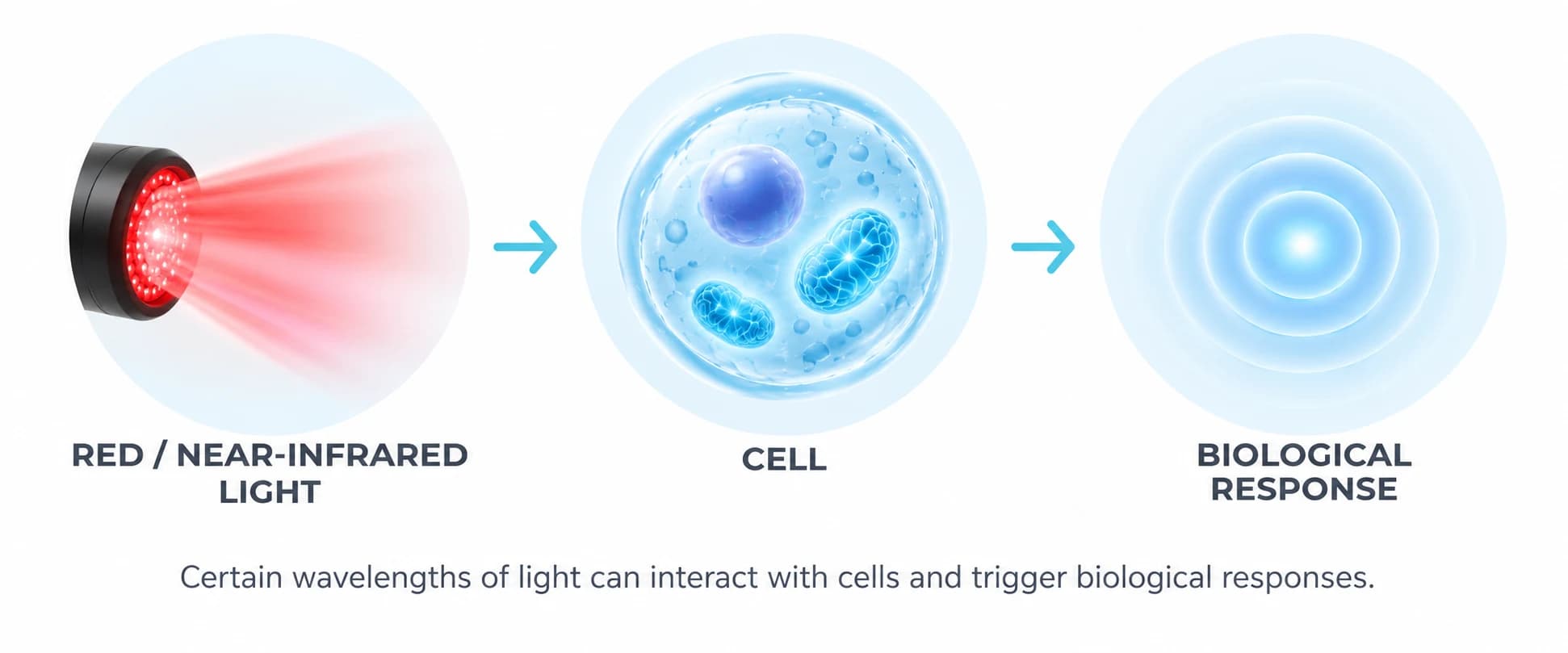
So what happens when red light reaches a cell?
This is where the science becomes more complex, and researchers are still working to understand all of the mechanisms involved.
One of the leading explanations involves light being absorbed by molecules associated with the mitochondria.
That interaction may influence mitochondrial activity and cellular signalling, including processes involving ATP, nitric oxide, reactive oxygen species and calcium.
Those terms can sound intimidating, but the bigger idea is much simpler:
Light appears capable of triggering biological responses inside cells.
And those responses may then influence other processes within tissues and the body.
Think of it as a conversation, not a power boost
This is an important distinction.
You'll sometimes hear red light therapy described as simply “giving your cells more energy.”
That's an easy explanation, but the biology appears to be more complicated than that.
Photobiomodulation seems to act more like a biological signal. The light interacts with the cell, and the cell responds.
Exactly how it responds can depend on many things, including the wavelength of light, the amount delivered, the tissue being targeted and the state of the cells themselves.
That's one reason researchers continue to study how different PBM protocols produce different effects.
The light doesn't do the body's work for it. It may influence how the body responds.
Why do wavelengths matter?
Not all light behaves in the same way.
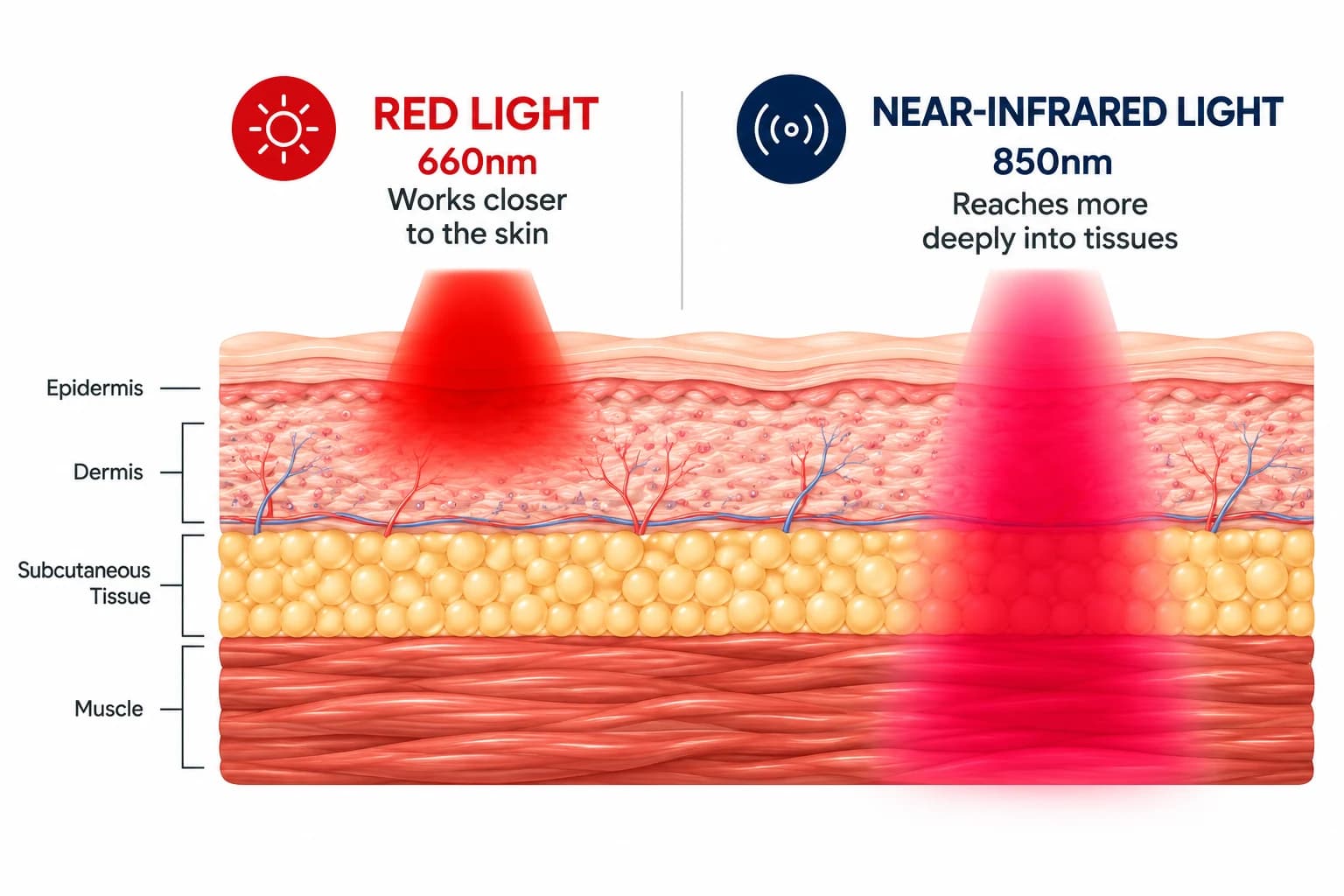
The wavelength of light helps determine how it interacts with tissue and how deeply it can travel into the body.
Red light is generally used for more superficial tissues, while near-infrared light can penetrate more deeply.
That's why you'll often see photobiomodulation research using wavelengths in both the red and near-infrared ranges.
Does more light mean better results?
No. And this is one of the most important things to understand about photobiomodulation.
Light needs to be delivered at an appropriate dose.
Researchers often describe photobiomodulation as having a biphasic dose response.
In simple terms, there appears to be a useful range of light exposure. Too little may not produce much of a response, while simply increasing the dose doesn't necessarily produce a greater benefit.
The ideal dose can also vary depending on the tissue, condition, wavelength and treatment being studied.
That's why using a red light device for longer and longer isn't automatically better.
With photobiomodulation, more isn't necessarily better. The right amount matters.
Why isn't every study identical?
If you've ever looked at red light research and wondered why one study reports a benefit while another doesn't, this is part of the reason.
Researchers may use different wavelengths, light intensities, doses, treatment times, distances from the light, treatment schedules and devices.
They're also studying different tissues, conditions and groups of people.
That means two studies described as “red light therapy” may actually be testing quite different treatment protocols.
Understanding those differences is one reason we don't believe a single study should ever be treated as the final word.
What does photobiomodulation mean?
After using the word throughout the website, it's probably worth explaining what it actually means.
Photo = light
Bio = living tissue
Modulation = influencing or changing a response
Put together, photobiomodulation describes the use of light to influence biological processes.
That's why you'll see the term PBM used throughout scientific research into red and near-infrared light therapy.
And frankly, red light therapy is much easier to say.
There's still plenty we don't know
The science of photobiomodulation has developed enormously, but there are still questions researchers are working to answer.
Which wavelengths are most appropriate for different tissues? What dose is ideal? How often should treatment be used? When does combining wavelengths matter? Why do some people or conditions appear to respond differently from others?
Those unanswered questions don't make the research unimportant.
They're part of how science progresses.
As better research becomes available, our understanding of photobiomodulation will continue to develop too.
You don't need to be a scientist to understand the idea
At its simplest, photobiomodulation comes back to something quite remarkable:
Certain wavelengths of light can interact with living cells, and those cells can respond.
From there, researchers are trying to understand what those responses mean for different tissues, different conditions and different areas of health.
That's the science we're interested in following.
And when we learn something useful, we'll do our best to explain it without making you reach for a biology textbook.